Categories
Bolivia Chile South America

Salt

There was no electricidad again.

This time we were in the tiny dusty nothing town of Uyuni, ready to set off on our 4WD tour of the amazing Bolivian salt flats. We’d left La Paz the day before on the bus, travelling to a forgettable town called Oruro up on the top deck at the front. Our seats were panoramico, apparently, according to the woman who sold me the tickets. And we certainly had a full and unobstructed view of just how crazy the drivers are in these parts, including our own driver of course–if I’ve got a full panoramico view of the road ahead and I can’t see around that blind corner up ahead, then I’m pretty sure he shouldn’t be overtaking. That was enough Bolivian buses for us, so in Oruro we jumped on one of the few remaining passenger trains in these parts, the Expresso del Sur, which wound its way down the country through some impressive scenery to deposit us later that night in a chilly Uyuni.

27th June 2008: View from the Train

This time a lack of electricidad didn’t mean that we had no water, just that the water was exclusively cold. Our shower, like most Bolivian showers we encountered, heated the water through an electric element in the shower head. But Uyuni was cold. So having no hot water was effectively the same as having no water at all.

As an indication of just how cold it was in Uyuni, we’d been woken from our sleep by the pleasant morning call of the lesser spotter backpacker, as one of our fellow hotel guests was being violently sick into one of the communal sinks in the courtyard just outside our room (these would be the sinks described by the Lonely Planet in its review of the hotel as being “great for laundry”). I wouldn’t have been volunteering to do any of my laundry in them that day, though, as when we left the hotel to find some breakfast we could see that his sick had frozen solid in the bottom of the sink into a sort of piece of abstract art. (And when we came back later to pick up our bags, the poor ladies from the hotel were pouring boiling water over it from a kettle and poking it with a stick to try to dislodge it. Rather them than me…)

*

The salt flats are every bit as stunning as we expected them to be, and there’s not much I can add that the photos don’t already show.

Salar de Uyuni

With such stunning scenery, it’s almost impossible to take a bad photo there. And it also seems to bring out the urge in everyone to mess around with trick photography–we went flying, as we’d seen someone else’s version of that shot back in Cusco, but other groups were taking it to another level. There were people there with props, playing with perspective to shoot themselves climbing into giant Pringles packets, pushing over giant footballs, standing on each others hands, and doing stuff like this.

After we’d spent the day hanging around on the salt, and visiting the spectacular cactus-filled island, Isla Incahuasi, we left the salar to spend the night in a hotel made of salt, in a small town called San Juan.

[I should point out that the salt hotel we stayed in wasn’t the salt hotel. There used to be at least two of these on the salar itself, but they’ve been closed down for environmental reasons. As the Lonely Planet colourfully puts it, they didn’t properly manage the waste, “essentially channelling it back into the same salty crust that you’ve come to admire…” We stopped at one of these hotels while we were on salar and saw that it has been renamed “a museum” (albeit a museum that sells drinks and has beds you can sleep in…)]

*

The second day of the tour took us to some more spectacular landscapes, but we were lucky to have got out to see it at all, as our morning had begun with the not so reassuring sound of a cold jeep refusing to start. It was eventually talked into cooperating (after a small nudge from the tour group), and apart from us subsequently pulling up in the middle of nowhere to let it cool down (“un pocito problema” according to the driver, who then jumped out and started throwing bottled water at the tyres) we made it through the rest of the trip, visiting funny shaped rocks, flamingos, and lagoons along the way.

*

The final night of our salt tour was not only the coldest of our trip so far, but also a timely reminder of why we haven’t been staying in dorms. As we slept in our sleeping bags, under the covers, and wearing all our clothes, listening to the cacophony of snores, grunts and moans coming at us in stereo from the other people on our tour in the dorm beds around us, we vowed to stick to the private rooms again from now on.

We also vowed that perhaps we should head for somewhere at a slightly lower altitude that might be a bit warmer, but as luck would have it, the start of the third day of the tour passed within spitting distance of the Chilean border, and so rather than head all the way back to Uyuni (which only offered more Bolivian buses, more freezing altitude, and no doubt more electricity-free hotels), we opted to jump off the trip and cross over to San Pedro de Atacama, a tiny tourist town just over the other side of the border down in Chile.

In fact, we’d technically left Bolivia two days earlier, when we’d got our exit stamps in our passports in Uyuni before the tour, although we wouldn’t enter Chile until we’d not only left the tour at the Bolivian border but also travelled a further 40 or so kilometres down to San Pedro. This confuses the hell out of me, by the way: where were we between stamping out of Bolivia and entering Chile, for starters. But then as someone who spent his formative years living on an island, I always find land borders a bit weird…

Bolivian Border...

Categories
Bolivia South America

The 1980s

Discover Bolivia Magazine...

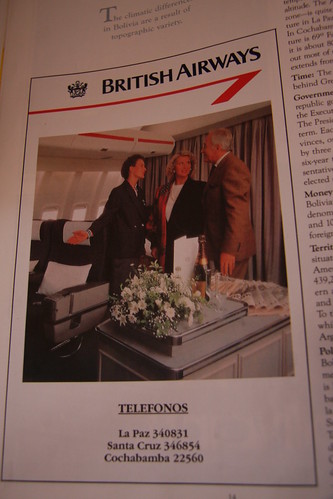
In our room at the hostel in La Paz was an ancient tourist information book, called Discover Bolivia, or something like that. It claimed to have been published in 1991, but it also included helpful information about the country such as “the currency of Bolivia is the peso…” which hadn’t been true since 1986.

In amongst the adverts for VCRs and other state of the art gizmos, I found this gem selling British Airways to the tourists of Bolivia. It’s not quite like that these days.

At the back of the book there was a page that said something like: “this copy of Discover Bolivia magazine is here for you to enjoy because other tourists have left it behind. Please do the same and leave this in your hotel room. If you would like to order a copy of your own, please fill in one of the attached tear off cards…” and, on the adjacent page, there was space for 6 detachable cards for tourists to fill in and send to the publishers with a cheque for $19.95. And even though the book had (presumably) been in the hotel room for almost 20 years, only 3 of the cards had gone.

Categories
Bolivia South America

How I Failed To Get Into Prison. And Other Stories…

After the peace and quiet of the island we returned to Copacabana to catch the bus to La Paz. All our other buses up to that point on the trip had been public buses mostly containing locals, but this time we’d somehow ended up on a bus entirely filled with fellow gringos. And even after being away in our own little world for just a short time, I’d almost forgotten that this continent is full of all these other identikit backpackers all doing the same stuff and going to the same places.

Our fellow travellers on this bus journey included an Irish guy who appeared to have stolen Billy Connolly’s hair. Within seconds of sitting down in the seat in front of me he’d reclined as far back as he could go, for maximum knee-crushing potential, and revealed to everyone within earshot that he was not happy. As I tried to regain the feeling in my lower legs I realised that this was because he’d come from Cusco, labouring under the misapprehension that he would be travelling on a directo bus to La Paz (if he’d really been going the fast route–via the Desaguadero border crossing–then he shouldn’t have even been in Copacabana at all, let alone having to change buses there). Unfortunately for him–and me–he’d ended up going the long way round, and when he realised that this route crosses the lake at Tiquina, and that we would all be chucked off the bus to jump on a ferry, while the bus travelled across on a floating platform of its own, he almost exploded.

*

Just before leaving Copacabana, we’d bumped into Lottie and James, who we’d previously met in Huacachina and Arequipa. They, too, were heading for La Paz, albeit on a different bus (presumably free of moaning gringos), along with their friend Nick, and so we had friends to catch up with when we got there. And when we did catch up with them, the first thing they told us was that they’d just signed up for a trip their hostel was organising to Willkakuti (“El Retorno del Sol”), the celebration of Aymaran New Year that was taking place that night (the winter solstice) at Tiwanaku, an archaeological site 70 odd kilometres out of town.

Did we want to come? They asked.
Well. Why not? Who needs to use that hostel bed you’ve paid for anyway…

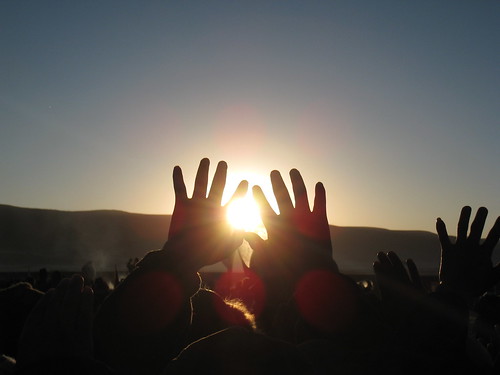
And so we found ourselves forgoing sleep to join a 1AM bus full of gringos heading out to the festival. We might have been half freezing (in spite of all the extra layers we’d brought and the dubious local rum we’d drunk while we waited for things to get going) but it was one of the best things of our trip so far. Joining the crowds on the site felt a bit like being at a weird South American version of Glastonbury, except with no music and where the only entertainment is the arrival of the sun…

Reaching out for the Sun's Energy...

I’ve no idea what happened to everyone else who had been on our bus, but we seemed once again to be mostly surrounded by locals (who explained what was going on, and told us that the thing to do was to put your hands in the air to soak up the sun’s energy). Oh, and then Evo Morales, the president of Bolivia, turned up in a helicopter to officiate at the ceremony. We couldn’t quite see what it was he was doing, but I did get to tick off the first item on my South American Presidential Bingo Spotting card (although having said that, it’s taken me so long to get round to writing this up, that he almost wasn’t president of Bolivia any more–he survived a referendum earlier this week–I don’t know whether that says more about how far behind I am in writing up this trip, or how quickly things can change in South America…)

*

When the ceremony ended we had to rush back to get to our bus, and so we joined a minor crush as everyone else tried to get out of the site down the same tiny flight of stairs that were woefully incapable of dealing with the volume of people who were there. While we waited to get out the locals around us laughed at me for being so tall and told me that I looked like that Doctor House off the TV show. Which is a new one for me…

*

Our journey back featured yet more moaning from the gringos on the bus. One of our fellow passengers described the two hour trip back to La Paz–in a comfortable half empty bus on mostly empty paved roads–as “the worst bus journey ever”.

Clearly the words of a man who hadn’t spent much time in Bolivia.

*

Oh yeah. The story of how I failed to get into prison isn’t actually as interesting as it sounds. We’d heard and read about La Paz’s famous San Pedro prison, where the guards turn a blind eye–if you slip them enough cash–to visitors coming in to meet a prisoner and see the city within a city inside, but we turned up without doing any proper research, expecting someone would just approach us like they do everywhere else, and it was only after this didn’t happen, and after I eventually plucked up the courage to ask the guards–in Spanish–if they’d let us in, that we realised that it wasn’t quite that easy.

I could come in, said the guard, if I knew who I wanted to visit. Oh. Right.

I opted not to try picking a name out of the air, and we left disappointed.

*

And that was mostly that for La Paz for us. We spent the rest of our time there hanging around with our friends, at least until I got my first bout of sickness of the trip so far, and had to spend two days in bed while an increasingly bored Sal went out to look at art galleries. And then it was time to head on to Oruro a little way down the country, where we were catching the train to the salt flats…

Categories
Bolivia South America

Bolivia

Sunset on the Isla del Sol

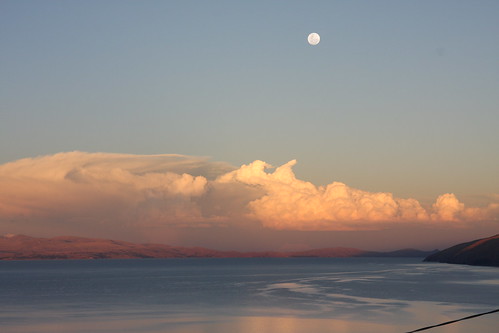
“No hay electricidad”, said the guy from the guesthouse as we made our way to our room. This we knew, as we’d just finished eating our delicious Lake Titicaca trucha criola by candlelight. We didn’t mind so much, as it sort of added to the charm of being one of just a handful of tourists spending the night on the quiet Isla del Sol, but I imagine it’s rather annoying if you live there (and it’s one thing eating Lake Titicaca trout by candlelight, but I’m not sure about having to cook Lake Titicaca trout by candlelight…)

If there was no electricidad, he went on to explain, there was also going to be no water. He pointed to the tank on the roof, the contents of which might otherwise have been pumped to our sink and toilet, and then to his wife, who was filling a large bucket that she was about to lug upstairs and deposit in our bathroom, demonstrating with a smaller bucket how we could use the contents as a makeshift toilet flush before bidding us goodnight…

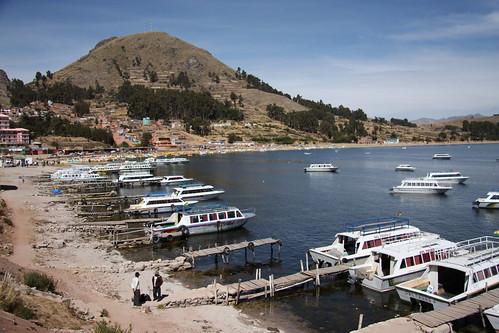
We’d come to the Island of the Sun after spending a couple of nights in the quiet border town of Copacabana, which is not at all like its Brazilian namesake. It’s a pleasant enough, laid-back little town, if a little touristy, where we relaxed and ate yet more trucha, went out on the lake in a pedalo (I did say it was touristy) and watched the world go by–including the “locals” who hang around the streets selling their craft work (they all look a bit like travellers who came into town but never left–I imagine you can probably tell how long they’ve been there by looking at the length of their dreadlocks, a bit like counting the rings on a tree). We also had a first in Copacabana–our hotel room had a telly. But it turned out to only get one channel, Bolivian state TV, and that seemed to show round the clock Che Guevara documentaries, so we weren’t exactly rushing home to watch it…

15th June 2008: Copacabana, Bolivia

To get to Copacabana, we’d taken an overnight bus from Cusco, and we were a bit anxious about this as we’d heard and read some horror stories about Bolivian buses in general, and the Litoral service we were catching in particular, but in the event it was fine, if a bit cold. In fact we were more annoyed by the other passengers than anything to do with the bus service, including the two guys on the seats opposite us who had decided to illuminate the otherwise entirely dark bus by looking at their entire selection of travelling photos on their iPod. Until Sal told them off.

On the flip side of being-kept-awake-by-bright-lights scenarios, when I woke up in the morning I peered through the curtains to see the most beautiful sunrise I’ve ever seen. We were travelling through a vast flat expanse, with the huge Lake Titicaca in the distance, and the sun slowly rising beyond that, the light reflecting back up off the lake and turning the whole sky a brilliant bright red. I could sort of see why this was the birthplace of the Incas’ sun worshipping mythology.

A little while later, the bus pulled to a stop at a fork in the road, and the 7 of us who were going to Copacabana, just over the border, rather than continuing on the fast road to the border crossing at Desaguadero, and then La Paz, were turfed off with our luggage and a lady from the bus company, and put onto a minibus for the 30 minute journey to the closer border crossing at Yunguyo. It turns out that our “directo” bus wasn’t quite so “directo” after all.

On the way, the lady from the bus company handed out Bolivian tourist cards for us to fill in, and we all started shakily scribbling in our details–the first of many times on this trip that I would make a barely readable scrawl on one of these things as our bus bumped along to a border. It’s just as well that no one ever really looks at them.

At the time I didn’t know that, though, and so I wondered if I mattered what I put for the question I didn’t understand: Días de permanencia? (helpfully translated into English as “days of permanency”). I asked the other gringos at the back of the bus if they knew what it meant. They weren’t sure, but they suggested it might depend on my visa.

“You do have your Bolivian visa, don’t you?” asked one of them, flicking through his passport to show me the sticker.

Oh. Really? My Bolivian visa? Oops. I was sure I’d checked this before we left, but surely they couldn’t have changed the rules? Could they?

Luckily it turned out that although they had changed the rules recently, the new requirements only apply to Americans. In the event, it was all fine. We were turfed off the minibus at the border and walked with our stuff to the Peruvian police check, where a disinterested Peruvian army chap stamped us out, and then across the street to the Bolivian side, where an equally nonplussed Bolivian army chap had stamped us in without even looking at the tourist card. And that was the start of country number 2–we piled back into a different minibus, which was then crammed to bursting with locals who were also making the 8km journey down into Copacabana, and we were on our way into town.

Categories
Bolivia Peru South America

Just Fancy That…

Lonely Planet: South America on a Shoestring (10th Edition):

pp864 (Peru Chapter): “Lake Titicaca: South America’s largest lake is also the world’s highest navigable lake…”

pp205 (Bolivia Chapter): “Lake Titicaca is deservedly awash with gushing clichés. Although it is often wrongly described as the highest navigable lake in the world (both Peru and Chile have higher navigable bodies of water)…”

Still, it could be worse, the Venezuela chapter (which is not one of the destinations on our itinerary) was written by Thomas Kohnstamm