Categories
Bolivia South America

Bolivia

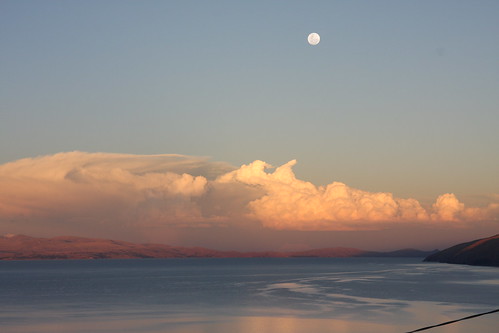
Sunset on the Isla del Sol

“No hay electricidad”, said the guy from the guesthouse as we made our way to our room. This we knew, as we’d just finished eating our delicious Lake Titicaca trucha criola by candlelight. We didn’t mind so much, as it sort of added to the charm of being one of just a handful of tourists spending the night on the quiet Isla del Sol, but I imagine it’s rather annoying if you live there (and it’s one thing eating Lake Titicaca trout by candlelight, but I’m not sure about having to cook Lake Titicaca trout by candlelight…)

If there was no electricidad, he went on to explain, there was also going to be no water. He pointed to the tank on the roof, the contents of which might otherwise have been pumped to our sink and toilet, and then to his wife, who was filling a large bucket that she was about to lug upstairs and deposit in our bathroom, demonstrating with a smaller bucket how we could use the contents as a makeshift toilet flush before bidding us goodnight…

We’d come to the Island of the Sun after spending a couple of nights in the quiet border town of Copacabana, which is not at all like its Brazilian namesake. It’s a pleasant enough, laid-back little town, if a little touristy, where we relaxed and ate yet more trucha, went out on the lake in a pedalo (I did say it was touristy) and watched the world go by–including the “locals” who hang around the streets selling their craft work (they all look a bit like travellers who came into town but never left–I imagine you can probably tell how long they’ve been there by looking at the length of their dreadlocks, a bit like counting the rings on a tree). We also had a first in Copacabana–our hotel room had a telly. But it turned out to only get one channel, Bolivian state TV, and that seemed to show round the clock Che Guevara documentaries, so we weren’t exactly rushing home to watch it…
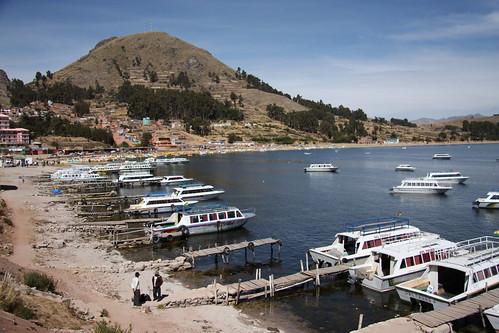
15th June 2008: Copacabana, Bolivia

To get to Copacabana, we’d taken an overnight bus from Cusco, and we were a bit anxious about this as we’d heard and read some horror stories about Bolivian buses in general, and the Litoral service we were catching in particular, but in the event it was fine, if a bit cold. In fact we were more annoyed by the other passengers than anything to do with the bus service, including the two guys on the seats opposite us who had decided to illuminate the otherwise entirely dark bus by looking at their entire selection of travelling photos on their iPod. Until Sal told them off.

On the flip side of being-kept-awake-by-bright-lights scenarios, when I woke up in the morning I peered through the curtains to see the most beautiful sunrise I’ve ever seen. We were travelling through a vast flat expanse, with the huge Lake Titicaca in the distance, and the sun slowly rising beyond that, the light reflecting back up off the lake and turning the whole sky a brilliant bright red. I could sort of see why this was the birthplace of the Incas’ sun worshipping mythology.

A little while later, the bus pulled to a stop at a fork in the road, and the 7 of us who were going to Copacabana, just over the border, rather than continuing on the fast road to the border crossing at Desaguadero, and then La Paz, were turfed off with our luggage and a lady from the bus company, and put onto a minibus for the 30 minute journey to the closer border crossing at Yunguyo. It turns out that our “directo” bus wasn’t quite so “directo” after all.

On the way, the lady from the bus company handed out Bolivian tourist cards for us to fill in, and we all started shakily scribbling in our details–the first of many times on this trip that I would make a barely readable scrawl on one of these things as our bus bumped along to a border. It’s just as well that no one ever really looks at them.

At the time I didn’t know that, though, and so I wondered if I mattered what I put for the question I didn’t understand: Días de permanencia? (helpfully translated into English as “days of permanency”). I asked the other gringos at the back of the bus if they knew what it meant. They weren’t sure, but they suggested it might depend on my visa.

“You do have your Bolivian visa, don’t you?” asked one of them, flicking through his passport to show me the sticker.

Oh. Really? My Bolivian visa? Oops. I was sure I’d checked this before we left, but surely they couldn’t have changed the rules? Could they?

Luckily it turned out that although they had changed the rules recently, the new requirements only apply to Americans. In the event, it was all fine. We were turfed off the minibus at the border and walked with our stuff to the Peruvian police check, where a disinterested Peruvian army chap stamped us out, and then across the street to the Bolivian side, where an equally nonplussed Bolivian army chap had stamped us in without even looking at the tourist card. And that was the start of country number 2–we piled back into a different minibus, which was then crammed to bursting with locals who were also making the 8km journey down into Copacabana, and we were on our way into town.

Categories
Peru South America

Assorted South America

Oh. Did I mention that you can buy any drugs you like over the counter here? There’s none of that time consuming “getting a doctor to write you a prescription” lark that we have at home, you can just wander into a pharmacy and ask for whatever you feel like. And then they sell them to you.

For the Inca Trail, for example, we prescribed ourselves some pre-emptive antibiotics, to avoid any potential awkward situations, and one day, after a particularly tough night in cramped seats on an overnight bus, Sal popped out to pick up some Valium for use on future journeys (well, the lady offered us a choice between Xanax and Valium, but we bought the Valium as it was a quarter of the price, at just S/.1 a tablet…)

*

With cheap laundries in every town, we quickly gave up on the concept of hand washing and have been dropping our stuff in to be washed and dried at regular intervals. This has had the interesting effect of gradually making all my clothes shrink. Every time they come back, my T-Shirts are marginally smaller than they were before, so presumably by the end of the trip I’ll be able to get so much more into my bag, as I’ll be able to squeeze my entire wardrobe into the side pocket.

One question remains, though: we’ve spent a significant proportion of the trip so far at altitudes above 2,500 metres, and all the laundries charge by weight. Is it more cost-effective to do your laundry at altitude, or do the laundries up their prices to compensate? Should I save up my dirty clothes for the next time we go up a mountain?

Categories
Peru South America

The Amazon

So after arguing the toss about exchange rates, and before heading south to Bolivia, we decided to blow the budget by heading to the Amazon. We’d read about this place called Inkaterra in the Indie travel section, so, Malaria pills in hand, we decided to hop over to Puerto Maldonado, on the Madre de Dios river in the Amazon basin, for a few days of luxury.

LAN Flight 73 to Puerto Maldonado...There are two ways to get there from Cusco. It’s either a tough eighteen hours on the back of a truck on unpaved roads, or a 30 minute flight that costs about $50.

No prizes for guessing which one we chose.

Buying the tickets was another interesting exercise in internet travel planning, though. When Lan.com refused to accept a UK credit card, we had to choose one of the “alternative payment options”, and these turned out to be the supermarket. Which is apparently a perfectly normal way to pick up a couple of plane tickets round here. You just take your code from the website, pop over to your selected supermarket chain, and join the queue at the checkout. Everyone else might be picking up a loaf and some milk, but they were more than happy to sell us two ida y vueltas to Puerto Maldonado. I think I’ll keep the supermarket till receipt that was ultimately our ticket as a souvenir.

We weren’t totally sure if it had worked, but a few weeks later they let us on the plane at Cusco airport, and after a short flight in the company of some moderately annoying and/or clichéd Americans (sample dialogue between the guy next to us–complete with thick noo yawk accent and waving a hat around in the general direction of the overhead compartment–and the steward: “hey Luis! Luis! You got room for this sombrero up there?”), we arrived in the ramshackle dusty town of Puerto Maldonado. It’s a town on the edge of the jungle, where the roads are mostly only wide enough for the motorbikes and tuk-tuks that are everywhere, and it instantly made me feel like I was back in Asia somewhere. And when we got to the “port” (a small wooden platform on the edge of the river) and boarded a long tailed boat for the 45 minute trip along the river to the lodge, it felt like we’d stepped onto the set of Apocalypse Now (this illusion was completed later that evening when the area around the lodge was illuminated with lines of candles and a raging bonfire). Still, we had hypo-allergenic pillows and complimentary bathrobes in our suite, and free Pisco Sours, so the choice not to go native wasn’t that tricky after all.

Madre de Dios

Categories
Peru South America

Cusco: Postscript

After the Inca Trail, we spent a few more days in Cusco. Tennille and Matt were in town, for one thing, so we spent a few days just hanging around with them.

Cusco starts to drag you down after a while, though. On the one hand, at least while we were there it was a town permanently in the middle of some kind of celebration. You could barely move for dancing kids in traditional costume every time we ventured even vaguely in the direction of the Plaza de Armas.

On the other hand, it’s a place so dependent on the tourist industry that you can barely move without having to fend off a tout of one type or another, be they selling tours you’ve already been on, or paintings or postcards you don’t want, or woolly hats (even though they can see that you’re already wearing one) or sunglasses (even though you’re also already wearing them). When a shoeshine boy approached me in the square offering to shine up my trainers we figured it was probably time to move on…

We foolishly opted to buy our tickets to Bolivia by going down to the bus station ourselves (even though it turned out that we could have bought them from an agent in town for the same price). It’s away in a dodgy part of town and turns out to be a huge room in which people behind desks shout place names at you really loudly, as if you might pop in there to buy a bottle of agua sin gas from one of the stalls, and end up with a ticket to Lima, just because a man shouted it your general direction…

*

Oh yes. I can’t move on from Cusco without a brief postscript to the Inca experience. We did have a couple of slight snags that deserve a mention. Our agency, Pachamama Explorers did a generally great job, with the exception of deciding to subtly raise their prices at the last minute before we left, and also leaving us semi-stranded in the middle of nowhere at the end. The bit in the middle might have been good, but unfortunately it was book-ended with the problems that I will inevitably remember…

The way back from Machu Picchu is by train, and Peru Rail likes to keep ’em separated: the super rich tourists (the Bill Gates and Clintons of the world) go to Machu Picchu on the Hiram Bingham, a luxury service with a free bar that’s a snip at just $588 for the 3 hour journey, while the regular tourists catch the Vistadome, which has panoramic windows to give them a great view of the beautiful scenery that they’re not walking through.

At the other end of the scale, after getting us up for breakfast on the final morning of the trek, the poor porters have to pack up all the gear and the tents and run (yes, run) from the campsite down to the station to catch their train, which leaves at 5:40 am. After our time at Machu Picchu is over, us backpackers catch a train called appropriately enough The Backpacker, which takes us back to Ollyantaytambo, about a 90 minute drive from Cusco. Finally, the guides catch a slow local stopping train (at a fraction of the price we pay and strictly for Peruvians only) that runs behind the backpacker. It is, as our guide Odon told us, “the system”.

It is also “the system” that all the agencies send transport to the station in Ollyantaytambo to collect their tired trekkers and take them back to their hotels, and we were told to expect a guy with a sign saying Pachamama to be waiting for us there, but apparently this bit of the system doesn’t work so well if the train is late, which is why we found ourselves wandering up and down an empty dusty street in the tiny middle-of-nowhere town with no lift in sight. When I eventually got hold of the lady at the agency (after paying some locals to borrow their mobile phone) she told me that they “never have problems with transport”, which is of course just what I wanted to hear after spending the previous 30 minutes wondering how exactly we were getting back to town. A few minutes later a bloke popped up from nowhere, pointed at us and said “Pachamama?” and went off to grab a guy who was standing next to the train station and was conspicuously not holding a sign saying Pachamama.

Tried and annoyed by this point, I threw a small gringo hissy fit as we walked to his waiting car. “How was I supposed to know that this was the guy?” I asked the pair in ungrammatical Spanish. “He has no sign!” It was only much later that it occurred to me that the reason that neither guy seemed to be able to answer this question (expect to say cryptically that “he didn’t know the name of the agency”) was that he probably wasn’t our original driver at all, and I had directed my anger at the wrong person. Oops. Sorry random taxi driver. At least we got home in the end; we just had to wait a bit longer for that first post-trek shower.

The other snag was when we went in to settle our bill on the day before the trek. When we’d booked the trek back in February, Pachamama had, like all the other agencies, quoted their prices in US$, but had asked us to pay in Peruvian Nuevo Soles. Which is fine, except that they had decided to fix the dollar/sol exchange rate at 3:1, which doesn’t quite match up to reality (at the time it was about 2.8 Sol to the dollar, which makes quite a difference when you’re paying almost $1000 for a tour and you’re trying to budget for a four month trip…)

It seems odd to me to run a business where the vast majority of your costs are in one currency but you set your prices in another. You could argue that the agencies price in dollars because the US is their major market, but if I was being cynical, I might suggest that the trekking agencies really do it because it’s traditionally been a strong currency and they can therefore subtly benefit from any increase in its value between the time people pay their deposits (which is months in advance for the inca trail), and the time they settle up. They clearly weren’t anticipating that the dollar’s value would drop so dramatically, but it didn’t seem quite fair for them to try to have it both ways by fixing the exchange rate at a level entirely unrelated to reality.

“I didn’t want to raise the prices” said Debbie from the agency, during our lengthy discussion on the subject, even though that’s effectively exactly what she’d done (as the amount we were now paying in Soles would now buy about $60 more than the amount we theoretically owed in dollars).

I was going to suggest that maybe she should consider hedging her currency risk, but she offered to meet us half way (probably more to shut us up than anything else) so I kept shtum.

Categories
Peru South America

Cusco and the Inca Trail

We had better seats on our night bus to Cusco, and so I was fast asleep in the morning when one of the other passengers tapped me on the shoulder to let me know that we’d arrived. We stumbled out of the bus into a particularly dusty yard where a guy from the bus company was throwing bags from the bus towards a crowd of people. We eventually got ours, and then a taxi and a hotel and some proper sleep.

When we emerged from the hotel, we found ourselves some breakfast up one of Cusco’s dauntingly steep streets, and went to sit in the Plaza de Armas. And just as I was saying to Sal that we’d probably see someone we knew at any moment, the Canadians we’d met in Lima and again in Huacachina walked right in front of us. Without really knowing what we were getting ourselves into, and still feeling the after effects of the overnight bus journey and the increased altitude, we joined them on a seemingly never ending bus tour around the city and up to the archaeological sites above it.

At the start of the tour, we passed a local with an old camera who was frantically snapping away in our direction. It was only later, when the same guy pursued us half way up the mountain to try to sell us postcards with our pictures stuck on them that I realised why. Of course I didn’t buy the blurry picture of me not looking at the camera, but I did realise that the next time I see someone pulling that trick I should tell him that it’s S/.5 for the photo of the gringo…

Oh, and I had to laugh when the tour guide started telling us all about how old Cusco is–older than nuevo york and washington dc… Well that sort of thing might impress the Americans on the bus, but if we’re having a “who’s got the oldest city competition” then I’ll see your 800 year old Inca civilization and raise you some Vikings and Romans. Stuff New York, what about Old York?

But of course we didn’t come to Cusco just to go on an average bus tour of the city and its associated Inca ruins, we came, like everyone else, for the Inca Trail and Machu Picchu.

They say that the Inca Trail is being “loved to death”, and it’s certainly true that, even limited to 500 people a day, there are lots of other gringos treading the same path as you. Luckily we’d booked our trip through an agency that was happy to send us off in a small group. Well, in fact a very small group, as it was just the two of us, and so this meant we could take our time, letting the other groups rush on ahead, and for the most part we had the trail to ourselves, with just the occasional porter speeding past. I did feel moderately guilty that it took 5 people just to get the two of us up and down a couple of mountains (that’s one guide, three porters and a cook), though. The porters truly are amazing. In the old days there were no restrictions on how much the dodgy agencies could give them to carry, but now they’re restricted to–just–the thirty kilos each. They run past you up the mountain barely breaking a sweat as you huff and puff up the hill (and on the second day, which is the toughest, when the tourists finally make it to the campsite having struggled up the delightfully named “Dead Woman’s Pass”, the porters give them a round of applause, which is surely the wrong way round…)

Inca Trail, Day Two: At The Top of Dead Woman's Pass

On the night before reaching Machu Picchu, we had the “tipping ceremony”, and of course as there were only the two of us in our group it fell to me to handle our part of this. I’m not sure I’m very good at that sort of thing. Adding something onto a restaurant bill is one thing, but actually physically giving someone money is just something I don’t know how to do. I think it’s a British thing. I’m sure the Americans get trained at birth on how to slip a $10 bill to the guy who’s just carried your bags to the hotel room or the Maître di at that fully reserved restaurant, but I’m never quite sure how to do it, or how much I’m supposed to give. At least this time we’d been briefed in advance on the going rate, and having seen how hard they work there was no question of us not tipping at the top end of the suggested range… They seemed happy enough, anyway, after I’d stumbled through some words of thanks and attempted jokes in my schoolboy Spanish (to the Quechuan speaking porters…) and passed them each the S/. 50 notes I’d been saving in my wallet…

(And this was after two amusing conversations with the porters: they’d asked how old I am, and had responded to my treinte años with “oh, we thought you were older, because of the grey hair…” and when we’d been discussing our families with Odon, our guide, who comes from a family of 7 brothers, we told him that we were from families of 2 and 3. “Oh, he said. What’s wrong with your fathers?”)

I think we both enjoyed the trail more than Machu Picchu itself, which was even at the early hour of the morning when we arrived there, already full of fresh-faced and clean tourists who’d just caught the train from Cusco… When we finally made it there, after a 4AM start, a wait in the queue to pass the final checkpoint at the campsite, a 50 minute walk to the sun gate and another hour to the site itself in time for sunrise, we were both too exhausted to do much else. They say you should climb Winu Picchu for the best view of the site, but when our guide finished our tour around the site, we just sat down for a long time.

Still, it was all in all an amazing experience, and certainly something my knees will never forget…

Categories
Peru South America

La Altituda

We made it out of Huacachina alive, though, surviving a tough hour’s slog up the sand dune directly behind our hotel to watch the sunset, as well as a bad lunch in a restaurant down the street that featured not only a fly in my coffee but also hairs on Sal’s straw and in my burger. Oh and the small matter of the taxi ride back to the bus station in the company of a driver who gleefully informed us half way there that he’d been drinking all day. It made for a scary final five minutes of the journey, although he didn’t seem to be significantly more dangerous than some of the sober drivers we’ve had so far…

After a night of knee crushing agony squeezed into my tiny seat (realising that being tall in South America isn’t necessarily a good thing) we arrived in Arequipa, Peru’s second city, and, at 2300 metres, our first baby steps towards altitude. Being a sensible type, Sal had already started taking Diamox, the anti-altitude sickness drug, but I’d foolishly chosen to hold off till Cusco. Perhaps it was indeed the altitude, or perhaps the after effects of the all night bus journey, but I found myself feeling decidedly woozy, and within a few hours had managed to spill an entire beer over myself at a bar overlooking the Plaza de Armas, and hit my head on a low bar on my way out of a restaurant so hard that it started bleeding. And of course, as we left said restaurant, with me still smelling of beer and clutching a small, thin Peruvian napkin to my head to stem the flow, we proceeded to bump into everyone we’d met so far on our travels, who all just happened to be walking down that exact street at that exact time…

Even then, I still didn’t start on the Diamox. Not until a few days later when we went off to the Colca Canyon (home to llamas, alpacas, the endangered Vicuñas, and many Condors). On the way there we reached a high point at over 4000 metres, and it really hit me, leaving me feeling sick and faint and having to have a sit down while Sal ran around with the camera taking photos.

Feeling the effects of the Altitude...

The pain was compounded shortly afterwards when we went for lunch with the rest of our tour group, a group that included an older Spanish couple who spoke no English, and a selection of other tourists who spoke English but no Spanish. This meant that responsibility for maintaining an awkward, stilted conversation fell to me as makeshift translator. All I really wanted to do was to go for a long lie down, but instead I was pushing the actually quite nice Alpaca steak around on the plate in front of me that the altitude sickness stopped me from wanting to eat while desperately trying to recall long forgotten verbs.

I started taking the Diamox straight away.

Luckily my translation duties for the day ended shortly afterwards when we left the Spaniards in their hotel and Sal and I went to nearby Yanque where we were staying. We almost had our hotel to ourselves. Apart from a couple of friendly Americans (the only other guests), the pet Alpaca, and the girl running the place, we were the only ones there. And after a short walk to the nearby natural hot springs, and back again over a rickety wooden bridge, we returned to the hotel for the coldest night of our lives. So far…

Baby Alpaca at our Hotel

Turns out those natty thermals I bought in the old people’s shop in Southport just before we left weren’t a waste of money after all.

And that was pretty much the end of Arequipa for us. After seeing the condors the next day we headed back to catch our night bus to Cusco…

Categories
Bolivia Peru South America

Just Fancy That…

Lonely Planet: South America on a Shoestring (10th Edition):

pp864 (Peru Chapter): “Lake Titicaca: South America’s largest lake is also the world’s highest navigable lake…”

pp205 (Bolivia Chapter): “Lake Titicaca is deservedly awash with gushing clichés. Although it is often wrongly described as the highest navigable lake in the world (both Peru and Chile have higher navigable bodies of water)…”

Still, it could be worse, the Venezuela chapter (which is not one of the destinations on our itinerary) was written by Thomas Kohnstamm

Categories
Peru South America

Sand

The problem with doing an amazing trip like this, is that you spend so long doing exciting things that you never have any time to write about them. And when you do, you’re so far behind that you can’t write about the exciting things you’ve just done, but only the ones that happened ages ago that you’ve almost forgotten about. For example, we’ve just come back from the Inca Trail, but if I started writing about that then I’d never get to tell you about the stuff we did two weeks ago. At least the photos are up to date (for now).

So where was I? Oh yeah, Ica…

*

Booking a bus ticket to Ica wasn’t without its problems. Cruz del Sur, the bus company we’d selected, have a moderately confusing website, which eventually claimed to have sold me some tickets (although only after rejecting my credit card twice, forcing me to register for “Verified By Visa”, and occasionally just changing the destination on my itinerary for no apparent reason). But we bought them in the end, and made our way to the terminal on Sunday morning feeling a bit average after a big and late Saturday night out in the bars of Barranco with some jovial Americans and assorted others from the hostel. We ribbed the Americans about having only 2 weeks’ vacation in which to see Peru, and they ribbed us about not having jobs. Yeah, I used to have one of those, I said. It was overrated…

The buses were surprisingly comfortable, although that may have had something to do with the fact that we’d picked the most expensive company–we’ll work our way down to the ones where you sit next to someone’s chickens eventually, but for now we’re sticking to the posh ones with reclining seats, meals, and DVDs. We did have to get the stewardess to turn down the volume on the tanoy, though, after an ear-splittingly loud announcement that seemed to go on forever. It was like the Spanish oral test from hell, but I stopped trying to understand after my ears started hurting, so let’s call that one a fail. (And after the oral, the DVDs they showed during the journey provided both a reading comprehension–also known as Training Day, in English with Spanish subtitles, which taught me some interesting swearwords–and then another listening test, in the form of some awful B-Movie called The Glass House, which we watched in dubbed Spanish with English subtitles.)

As well as showing bad movies, the posh buses also serve you food. Perhaps foolishly, I’d left the food choice set to Qualquiera (“Whatever”) when I bought the tickets, and that was a pretty accurate description of the random selection of meat and rice that turned up in front of us in a small tray. It was washed down with my first Inca Kola of the trip. It’s a ubiquitous South American soft drink that basically looks like radioactive piss in a bottle, and tastes as odd as that sounds, but I’m led to believe that if you travel in these parts for long enough you’ll grow to love it. We’ll see…

The journey to Ica took about 5 hours, through some interesting countryside. Sometimes desert, sometimes abandoned crumbling concrete buildings, the occasional apparently deserted shanty town and some post-quake rubble. The stop before Ica was Paracas, which appeared to have been particularly badly hit–when we reached Ica we shared a cab to Huacachina (just a few kms away) with a Canadian girl who’d been staying there and who told us that there was nothing left there, including no bank, which had meant that she hadn’t eaten for a day as she hadn’t been able to afford to get anywhere that did have a cash machine until her bus came…

Discussing this in the cab, the driver told us that he’d felt a tremor in Ica just a few hours ago…

The Lonely Planet describes Hospedaje El Huacachinero, which we’d decided to stay in, as “rickety”, “basic”, and “a work in progress”, but it was anything but. In fact it was more like a hotel than a hostel (and a little bit more expensive than The Point at S/.80 per night for the two of us–14 quid–rather than S/.64 we’d been paying in Lima), but, intrepid travellers that we are, even after just a few days on the road we were already wowed enough by the prospect of our own bathroom, with towels and everything, that we were prepared to pay the extra.

Sand Boarding, Huacachina

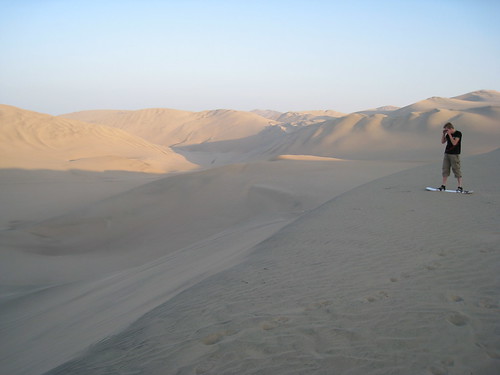
We’d come to Huacachina for the sand. It’s a little oasis of hostels and hotels in the middle of a desert of sand dunes. All the hotels have these big green dune buggies and they drive you up to the top of the dunes and back down again at laws-of-physics-defying angles. It’s a bit like being on a roller-coaster except driven by a laughing manic and with the very real possibility of death. Best of all, when you get to the top they chuck you out of the buggy and give you a small plank of wood with which to get yourself down again. You can either go down standing up, Snowboarding style, or if you’re not suitably skilled you can just lie down on your stomach and let gravity do the rest:

Sand Boarding, Huacachina

Fantastically good fun, although the sand does go everywhere.

Categories
Peru South America

On The Way

And so that’s it. After finishing up at work last week, then cleaning the house and leaving London on Sunday, and a few days back in Southport with the family that passed all too quickly, we’re finally off on our big South American adventure. I feel moderately underprepared, but we’ve got a wallet full of plastic, a flight ticket home in September (we just have to get several thousand miles across the continent to Sao Paulo to use it…) and a bed to sleep in tonight, so I’m sure it will all be fine.

As I write these words in my notebook–words that I hope to be able to transfer onto the interwebs when time and connectivity allow–it’s Thursday 22nd, and we’re currently, as the captain and the sky map have just informed me, “overflying the city of Manchester”. Which is ironic, really, given that that’s where our convoluted Manchester – Frankfurt, Frankfurt – Caracas, Caracas – Lima itinerary started several hours ago. We’ve spent a couple of hours in the slightly shabby Frankfurt airport, eaten some bad airport and airline food, and now we’re back where we began, albeit several thousand feet higher than we were when my dad dropped us off in the early hours of this morning…

*

We eventually got to Lima late on Thursday night, where there was a man with a board with my name on it waiting to take us to our home for the next couple of nights. The clock on my phone, which was still in UK time, told me that we’d been up for almost 24 hours. We managed a couple of beers in the hostel bar and a toasted sandwich before heading to bed.

*

Today we decided to take things easy, with a relatively late start and no real plans, beyond working out what we’re doing for the next few days and recovering from our day on the plane.

After Lima, which we’re hoping to leave shortly, we thought we might go to a place called Chincha, a few hours down the coast, so we jumped on the internet to try and book into a hotel that had been recommended by a blog Sal had read. Unfortunately the enquiry form on the hotel’s website didn’t seem to be working. No matter, we thought, as we took down the phone number and went off to ask the guys in reception. “Why do you want to go there?” they said, when we told them of our plans. “Um. I dunno. Someone recommended it?” I suggested as we went off to the phone with the phonecard they’d just sold us to give the place a call… We started to get the idea that maybe this wasn’t meant to be when the phone number of the hotel’s Lima office produced just a message in Spanish telling me that there was in fact no such number, and the local number produced only a message in Spanish telling me that I had to phone a new number… and that number produced only another message in Spanish telling me that it also didn’t exist.

Ah! I spotted in the Lonely Planet that their Lima office is just down the road from our hostel in Miraflores, so off we went in a cab to have a bit of a wander around the area and see if we could book it from there.

The second indication that maybe we wouldn’t be staying in Chincha was when their Lima office turned out to be little more than a private house with nobody home. We gave up and wandered off to the beach to drink some very expensive drinks at a restaurant looking out to the Pacific.

The third indication that maybe we wouldn’t be staying in Chincha was when we returned to the hostel to try the internet again. This time a bit of calculated googling produced the information that the hotel is in fact closed until 2009 for repairs following last year’s earthquake. Oops.

We booked a bus ticket to Ica instead.